
















Home Blog Page 54

UK running out of gas, National Grid warns

0

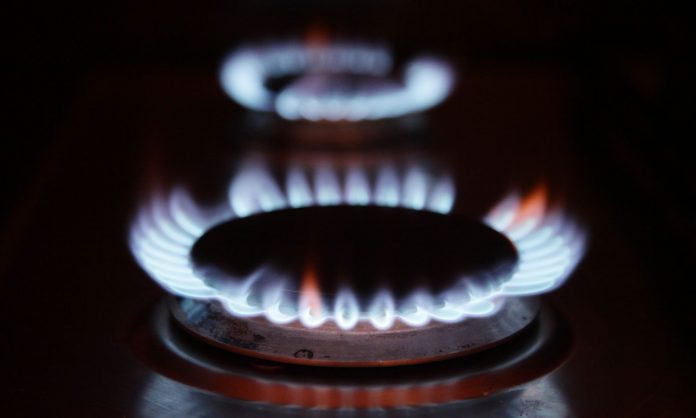
National Grid has issued a warning that the UK will not have enough gas to meet demand on Thursday, as temperatures plummeted and imports were hit by outages.

The government said households should not notice any disruption to their supply or any increase in energy bills because suppliers such as British Gas buy energy much further ahead. Energy minister Claire Perry said people should cook and use their heating as they would normally.

Within-day wholesale gas prices soared 74% to 200p per therm after the formal deficit warning, which acts as a call to suppliers to bring forward more gas. It is the first time such an alert has been issued since 2010.

By lunchtime on Thursday the price had spiked even higher, hitting a high of 275p per therm at one point.

National Grid’s forecast for the day initially showed a shortfall across the day of 49.5m cubic metres (mcm) below the country’s projected need of 395.7mcm, which would normally be around 300mcm at this time of year. The gas deficit warning aims to fill the gap, which has since narrowed to 16.5mcm.

“We are in communication with industry partners and are closely monitoring the situation,” the company said.

Widespread snow and temperatures of -7.8C due to the “Beast from the East” and Storm Emma have prompted consumers to fire up their heating. Public health authorities recommend an indoor temperature of 18C.

As a result gas demand is at a five-year high, according to market watchers S&P Global Platts.

Simon Wood, a gas analyst at the group, said: “There’s a strong chance you’ll see some interruptions for industrial users to balance the system.” Big energy users such as car manufacturers have supply contracts which can be interrupted in return for lower prices.

The situation has been compounded by several outages to supply, which can experience problems in very cold weather. There have been problems with a pipeline to the Netherlands, reductions in gas flows from Norway and technical issues at facilities in the UK, including the North Morecambe Barrow terminal.

The crunch is also the UK’s first major energy security test since the country’s biggest gas storage facility was closed by Centrica last year. The Rough site in the North Sea had accounted for 70% of the UK’s gas storage.

The UK is currently drawing on stores of gas dotted around the country, and liquified natural gas at the Isle of Grain in Kent and Dragon in South Hook, Wales.

Gas storage is currently at the lowest level since records began in 2006, primarily because of the closure of Rough. The UK currently has around 0.7 billion cubic metres (bcm) of gas stocks out of a total capacity of 1.3bcm. That total used to stand at 4.5bcm.

Wood said that ensuring there is enough gas in the next few days would be “touch and go”.

Normally, energy demand dips at the weekend but that effect will be limited this Saturday and Sunday because the cold temperatures keep more people indoors and bump up household demand.

One analyst said that while this week’s short-term problem had been caused by a “perfect storm” of unrelated issues, the government has failed to take long-term action on gas supplies and cut demand by encouraging energy-efficient homes.

“The UK is largely isolated in its dependency on gas, with a huge over-reliance in the power and heating sectors. Experts have long warned about putting too many eggs in the same basket, with events such as today the undesirable outcome,” said Dr Jonathan Marshall, energy analyst at the ECIU thinktank.

The government is due to meet an alliance of energy intensive industry groups and trade unions after they wrote to the business secretary, Greg Clark, last November demanding an inquiry on gas storage and supply.

“We’ve had the Forties [pipeline] disruption [in December], other events in January and February. We envisage the frequency of these will increase, and this will have impact on gas prices. This requires an inquiry,” said Clive Moffatt, speaking for the group, whose members include ceramics and paper firms.

The shale industry said today’s deficit warning showed the UK’s need for homegrown gas supplies extracted by fracking.

The jump in gas prices is much higher than the one in December after a major North Sea pipeline was closed for repairs.

The high price of gas, which is expected to last for the rest of the week, has also had an impact on electricity supplies, leading to a surge of dirty coal power.

The amount of electricity generated from oil in February was up 81% on January, and over the last seven days more than a fifth of power came from coal, according to MyGridGB.

Power prices, which would usually be around £45-50 per megawatt hour at this time of year, have spiked at an astronomical £990 per mWh on Thursday.

Source https://www.theguardian.com/business/2018/mar/01/uk-is-running-out-of-gas-national-grid-warns-freezing-weather

Facebook finds no substantial evidence of Russian meddling in EU referendum

0

Facebook has found no further evidence of Russian propaganda activity around the EU referendum, after being forced by MPs to carry out a more detailed investigation than it initially performed.

In December, Facebook reported just $0.97 (71p) was spent by Russian-based actors on ads that targeted British users in the period leading up to the referendum. It also said that that money was apparently the result of misfires from the large Russian campaign targeting the US election.

But the House of Commons committee that requested the investigation was unhappy with the result, arguing Facebook had not answered the questions put to it and forcing the company to do a more thorough investigation.

That investigation is complete, says Facebook, and the results remain the same. “The investigation team found no additional coordinated Russian-linked accounts or Pages delivering ads to the UK regarding the EU Referendum during the relevant period, beyond the minimal activity we previously disclosed,” said Simon Milner, Facebook’s UK policy director, in a letter to Damian Collins MP, the chair of the DCMS Committee.

“These findings are in contrast with the results of our investigations into organised Russian activities targeting the US,” Milner added. “Before our investigation had uncovered the [Russian] activity on which we testified to the US Congress, the US intelligence community had stated publicly that Russia had attempted to interfere in the US election

“We are not aware of any comparable findings or investigation of this nature by UK authorities. If such investigations were to occur and findings shared in respect of illegal activity in the UK against named individuals or organisations, we would of course be prepared to assess the existence and extent of any relevant activity by them on Facebook.”

In response, Collins welcomed the cooperation, but noted that Facebook has still not provided all the information it promised. “I look forward to them sharing with us, amongst other information: the exact number of accounts that they have suspended; how they are resourcing their fight against bots; their methodology of how they identify fake accounts; and how they determine what country those accounts come from. They have promised this to us in full by 14 March 2018.

“We have also asked Facebook for further points of clarification relating to the letter they have given to us today.”

Source https://www.theguardian.com/technology/2018/mar/01/facebook-evidence-russian-meddling-eu-referendum

Scotland seek way to win away in a Six Nations lacking consistent refereeing

0

Finding a way to win away. It was a conundrum that ensured Gregor Townsend did not get carried away last Saturday by Scotland’s first victory over England in 10 years. The head coach was already thinking about their next match against Ireland in Dublin and how to end years of failure on the road in the tournament.

Scotland’s last away victory to one of their old Five Nations rivals was in Dublin in 2010. For many Six Nations campaigns they were little better at Murrayfield, but in the last two years they have defeated Ireland, Wales, France and now England in front of their own supporters.

A few pages have been turned but Townsend is now on a new chapter. For all the elation at Murrayfield last weekend, it was only a few weeks ago that he was reflecting on a day in Cardiff that had promised so much and delivered so little.

Factor out Italy, whose last victory in the tournament in Rome was in 2013, and home advantage has become significant in the Six Nations. Coaches, when they are preparing for away matches, talk about the venue they will be travelling to as another strip of grass and how players are able to blot out the crowd, but Scotland fed off the emotion of their supporters, starting in the tunnel after the warmup.

Last year’s Six Nations was decided not by the bonus points system but England’s late victory in Cardiff; other than Italy, Wales were the only side to lose at home. This year, Ireland’s even later plundering of the points in Paris has put them in a position where they could secure the title with one round to go.

The England head coach, Eddie Jones, said before the Scotland game that England had had two “very good” training weeks and that they were becoming a robust, mentally tough team that was not fazed by hostile environments. “You don’t hear Manchester City talk about playing away from home,” he pointed out.

England failed to strip the emotion out of the occasion and conceded three tries in the opening half. A concern for Jones was their failure to solve problems before receiving advice from the coaches during the interval. They had talked in the buildup about the importance of the breakdown but were lacking in that area.

It was a day when the wisdom of playing Chris Robshaw on the openside, which Jones questioned during the 2015 World Cup, was thrown back at him, never mind that the Harlequin saved a potential try in the first half with a turnover near his line. It was a system, rather than individual, failure, with England failing to adapt to the way the referee, Nigel Owens, controlled the breakdown.

Owens is a Pro14 referee, a tournament in which a longer contest for possession is allowed than in the Premiership where the team taking the ball into contact will be allowed to recycle it unless the ball-carrier is isolated and forced to hold on. Opensides such as Justin Tipuric, Hamish Watson, Dan Leavy and James Davies are of greater value in the Pro14 than they would be in England because games break up more and their roles are more traditional.

The breakdown was refereed far differently in Dublin last weekend where New Zealand’s Glen Jackson, who spent much of his senior career in England with Saracens, gave the defending side little latitude. Ireland had prepared for him, coming in at the side to either seal off or take away the legs of the Wales player contesting for possession, and it was Wales who gave away the penalties.

Three out of four teams had to deal with unfamiliar refereeing interpretations but only one did so successfully. It raises the question why there is not more cross-pollination of officials between the three major leagues in Europe rather than only the two European tournaments. While the system of elite referees is meant to spread consistency, they are all conditioned by where they hail from, and in the southern hemisphere and the Pro14 there is more emphasis on entertainment than in the Premiership or Top 14.

What was less of a surprise than Scotland’s victory, given their notable improvement at Murrayfield in the last couple of years, was the general reaction to England’s defeat. When the All Blacks lost to Ireland in 2016 the focus was on the victors but after Murrayfield, with a few doffs to Finn Russell and Huw Jones, it was as if England had been kicked out of the World Cup; goodbye to Mike Brown, Dylan Hartley and all that.

It will be about England’s response in Paris against a France side that ended a long winless streak against Italy, in Marseille, comfortably rather than convincingly. The loss of Billy Vunipola leaves a hole no one can fill, just as the series of injuries to Manu Tuilagi have denied Jones the chance to mould him into an inside-centre.

England have not been knocked off course, just given a jolt in a Six Nations championship that has never been more competitive with Scotland abandoning the wooden spoon pursuit. France may be playing catchup in terms of squad organisation but they take some beating. It has been a fascinating tournament and it still has a way to go.

Source https://www.theguardian.com/sport/2018/mar/01/scotland-win-away-six-nations-lacking-consistent-refereeing-breakdown

Putin threatens US arms race with new missiles declaration

0

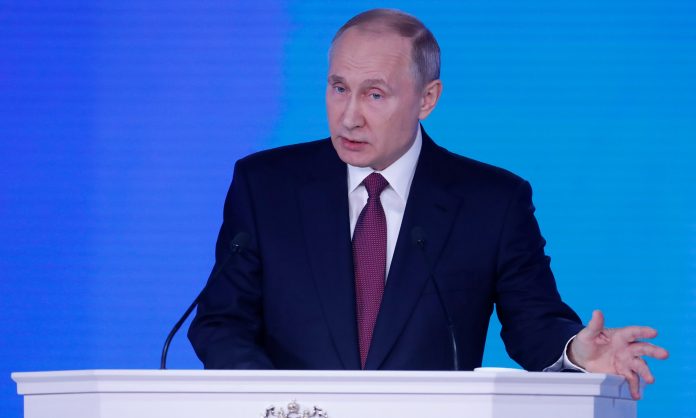
Vladimir Putin has announced that Russia has developed and is testing a new line of strategic, nuclear-capable weapons that would be able to outmanoeuvre US defences, suggesting a new arms race between Moscow and the west.

Speaking in a nationally televised address to the country’s political elite weeks before a presidential election, the president showed video and animations of ICBMs, nuclear-powered cruise missiles, underwater drones and other weapons that he said Russia had developed as a result of the US pulling out of the 1972 anti-ballistic missile treaty signed with the Soviet Union.

“You didn’t listen to our country then,” Putin said during the speech on Thursday. “Listen to us now.” Some of the weapons were already being tested, he added.

The speech came in the same month that the Pentagon released a new nuclear arms policy, which followed on from a promise by the US president, Donald Trump, to develop an arsenal “so strong and powerful that it will deter any acts of aggression”. The policy envisioned low-yield nuclear weapons on submarine-launched ballistic missiles that could counter similar Russian weapons.

Putin issued a message of defiance. “I would like to tell those who have been trying to escalate the arms race for the past 15 years, to gain unilateral advantages over Russia, and to impose restrictions and sanctions … The attempt at curbing Russia has failed,” he said.

His remarks came during a state of the union speech heavy with economic promises for the Russian people and sabre-rattling against the US. It was widely viewed as his first campaign speech for Russia’s presidential elections on 18 March. The Kremlin is primarily concerned with boosting turnout as Putin is expected to cruise to a fourth term as president.

There were signs that the authorities wanted to attract extra attention to the speech by moving it from the gilded St George’s Hall at the Kremlin to an exhibition space in central Moscow where video and infographics could be shown.

The first hour of the speech was conventional, if optimistic. Putin promised to raise life expectancy by 10 years, increase Russia’s GDP by 50% by 2025 and halve the poverty rate. He said Russia would have to latch on to a wave of technological advances or risk “drowning in that wave”.

The interactive presentation began with graphs showing birth rates and harvest totals in recent years, but it was mainly used as a platform to show off Russia’s latest weaponry, some of it capable of delivering a nuclear strike anywhere in the world.

Putin highlighted a test of Russia’s RS-28 Sarmat missile. According to state media, the ICBM is able to fly 6,800 miles with a payload of 15 warheads, though the actual capabilities of the missile have not been shown. The Russian defence ministry said it had conducted a successful test launch in October, during which the missile had travelled 3,600 miles before hitting a target area in Russia’s far east.

Putin also said Russia had developed a working laser weapon, a hypersonic missile and a cruise missile powered by a nuclear reactor that could fly indefinitely.

He said the plane-launched hypersonic missile, called Kinzhal or dagger, could manoeuvre while traveling at more than 10 times the speed of sound, making it “guaranteed to overcome all existing and I think prospective anti-missile systems” and deliver a nuclear strike. Putin claimed it had completed testing and was already in use.

He also spoke about the RS-26 ballistic missile, Avangard, which Putin said “heads towards its target like a meteorite”. The missile has already raised concerns in the US about its compliance with global arms treaties.

Putin also showed several animated videos of prototype weapons, including a nuclear-powered cruise missile that could theoretically have a limitless range. He showed it navigating anti-air defences in the Atlantic Ocean before skirting the coast around South America and heading for the California coastline before the video faded to black.

After each demonstration, the crowd applauded.

Russia has been aggressively marketing its latest military tech. Its first stealth fighter, the Su-57, was deployed to Syria forcombat testing last week. Analysts said the jet’s capabilities were still not clear, and said that the deployment could be designed to show the Su-57 programme was moving forward despite time and cost overruns.

In a nod to public opinion, Putin announced an online contest to name Russia’s new cruise missile and underwater drone.

Putin has given the constitutionally mandated speech on “the situation in the country” 14 times since he first became president in 2000. He did not do so during the four years he was prime minister.

His address, which generally lasts around an hour, is given to an audience of lawmakers from the state Duma and federation council, judges, ministers and other members of the political establishment, and generally focuses on domestic issues such as the economy and corruption.

Source https://www.theguardian.com/world/2018/mar/01/vladimir-putin-threatens-arms-race-with-new-missiles-announcement

Not the end of The World: the return of Dubai’s ultimate folly

0

Ihad the whole of Palestine to myself that day. It was only a short swim from Lebanon but, as I waded ashore out of the shallow, soupy water, it became clear that I was the only visitor the island had seen for some time. Clambering to the top of the hill, over a lunar landscape populated by the occasional piece of driftwood and the odd discarded beer bottle, I could see the sandy mounds of Jordan, Saudi Arabia and Ethiopia beyond, rising out of the sea like bobbing croutons. The gleaming spire of the Burj Khalifa twinkled through the haze on the distant horizon.

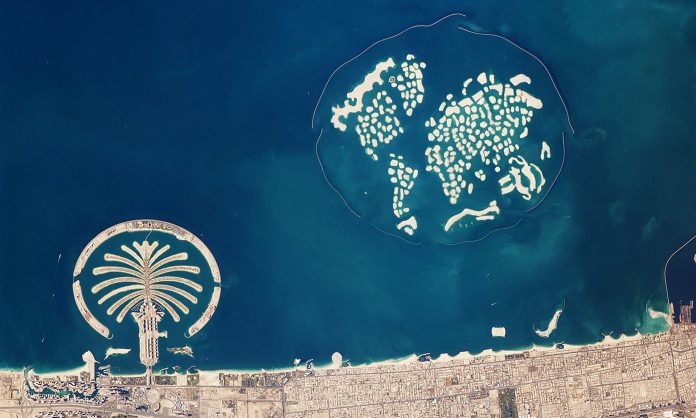
A decade since it was dredged from the seabed, The World is a forlorn sight. It was the most ambitious plan of Dubai’s pre-crash bubble, topping the creation of peninsulas shaped like palm trees and the construction of the tallest building on the planet, dreamed up as the ultimate trophy project to trump them all. In pursuit of the world’s attention, the oil-rich emirate would remake the world itself. “The Palm puts Dubai on the map,” proclaimed the marketing material at the time. “The World puts the map on Dubai.”

Conceived in 2003, the project was to be an exclusive offshore playground for film stars, royalty and celebrity tycoons: an artificial archipelago of 300 islands set two miles off the coast. Invitations to “Own the World” were sent to a targeted group of 50 potential buyers each year, offering tours of the site by yacht or helicopter, with prices for the islands ranging from $15-50m (£10-36m). Richard Branson posed for photos on little Britain in a Union Jack suit; Karl Lagerfeld launched plans for a fashion-themed island; rumours swirled that Brad Pitt and Angelina Jolie had acquired Ethiopia for their ever-expanding clan of adopted children.

Trees won’t be the only things bobbing in the water. Given the high premium on land, his firm is developing plans for entire floating islands, beginning with Venice. Gondolas will weave between modern palazzos, set around a swimming pool proportioned to match St Mark’s Square, while underwater bedrooms and restaurants will provide views on to a new coral reef. He says they have already established a coral nursery on one of the islands, and plan to cultivate oyster beds too, with pearl-diving added to the list of attractions on offer.

Wading through the murky water today, it is hard to believe the Photoshopped visions of people frolicking among shoals of exotic fish in a crystal-clear lagoon, lounging in their underwater lairs or playing in the snow. Kleindienst says the entire development and its 4,000 bedrooms will be completed in time for the Dubai Expo in 2020, which seems impossibly tight. He insists that most of the Floating Seahorse villas have been sold, promising investors a guaranteed yield of 8% over five years; but these figures are hard to take seriously when current prime residential property yields in Dubai stand at around 5%. Nor might it be of particular encouragement to investors that one of Kleindienst’s structures recently sank following a New Year’s Eve party.

For all the hype, industry insiders raise their eyebrows at the idea that The World is back on track. “When you go into these marketing suites, it feels like 2007 all over again,” says Dubai-based architect Sara Anwar, who was involved with Karl Lagerfeld’s plans for a fashion island, Isla Moda, before the financial crisis hit. The project, developed by Dubai Infinity Holdings, was to include a fashion resort, themed residential villas, haute couture boutiques and luxury hospitality facilities, all aimed at ultra-high net worth individuals (or UHNWIs as they are known – an acronym that, when pronounced, sounds appropriately like “unwise”).

Source https://www.theguardian.com/cities/2018/feb/13/not-end-the-world-return-dubai-ultimate-folly

Theresa May at risk of Commons defeat as Labour shifts on Brexit

0

Jeremy Corbyn could use a key Brexit speech on Monday to pave the way for Labour to inflict a Commons defeat on the government, by backing a rebel Tory amendment seeking to keep Britain in “a customs union”.

With Theresa May expected to unveil her vision for departure from the EU next week, following eight hours of talks with key ministers at the prime minister’s Chequers country retreat, she now faces the prospect of Labour sabotaging the carefully choreographed process.

In what will be a closely watched speech, Corbyn is expected to signal that Labour is prepared to back the UK staying in a customs union with the EU.

The party has said for some months that customs union membership is a “viable” outcome but a series of interventions from shadow cabinet members in recent days, including Emily Thornberry and John McDonnell on Thursday, have suggested Labour is edging towards making it the preferred result.

Drafts of the speech have been circulating, with some shadow cabinet members insisting it would mark a significant departure. But other senior Labour figures suggested Corbyn would merely “flesh out and deepen” the party’s existing stance; and some shadow ministers are concerned about alienating pro-leave Labour voters.

Tory rebel Anna Soubry responded to the apparent shift in Labour’s position by tabling a fresh version of an amendment to the government’s trade bill, calling on the government to remain in “a customs union”. She said a large number of Tory MPs had already contacted her to offer their support.

The bill is not expected to return to parliament until after Easter, and Labour has not yet made a firm decision on which amendments it could back.

But if Corbyn whipped his MPs to support it, Conservative MPs could inflict a highly damaging defeat on May that would amount to a direct challenge to the prime minister.

Corbyn’s speech on Monday will come as May prepares to ask her full cabinet to sign off on the outcome of Thursday’s all-day meeting of her 11-strong Brexit strategy and negotiation sub-committee, known as her ‘war cabinet’, at Chequers.

The conclusions of the talks will be put to the full cabinet on Tuesday morning and, once agreed, outlined by May later in the week, in a speech being billed by No 10 as a major step in outlining the government’s final Brexit strategy.

Eight hours of talks at the 16th-century mansion in Buckinghamshire, broken up by a dinner of sweetcorn soup and beef rib with parsnip mash, saw May and members of her senior team lead discussions on elements of the Brexit strategy, a Downing Street source said.

May led on “the overall future economic partnership the UK wishes to reach with the EU”, they said, with Michael Gove, the environment secretary, helming the talk on agrifoods. Business secretary Greg Clark spoke on the auto industry and international trade secretary Liam Fox spoke on digital trade.

One senior Brexiter claimed that “divergence was the victor” in the Chequers talks, with the prime minister making a decisive intervention – though it will be unclear what that could mean in practice until she delivers her speech.

The degree to which the UK will be able to vary its laws and regulations from those of the EU after Brexit has been a key sticking point.

The meeting at Chequers came amid a frantic period of activity by May and her ministers as they seek to cement a final Brexit policy acceptable to all, which has already seen Boris Johnson and David Davis make speeches.

The prime minister is expected to make her own contribution next week, possibly on Thursday. Clark is also due to speak about Brexit at the Mansion House in the City of London the same day.

One senior Conservative MP and former minister said neither the Chequers summit nor May’s speech were expected to involve any major announcements or shifts of position.

“I think it will be incremental,” they said. “I don’t think Theresa May does big and bold. Expectations are definitely low.”

The MP said a key indicator of how close the cabinet was to agreeing on a policy would be whether or not individual ministers continued to promote their own agendas, as when Johnson contradicted May shortly after her Brexit speech in Florence in September.

The amendment to the trade bill is expected to win the backing of other Conservatives who inflicted defeated on the government last year on the EU withdrawal bill, including Dominic Grieve, Stephen Hammond, Jeremy Lefroy, Antoinette Sandbach and Jonathan Djanogly — all of whom had signed up to a similar amendment calling for the government to remain in “the” customs union.

Corbyn’s speech and Labour’s newly agreed position on the future economic partnership was the subject of intense discussions at the “away day” gathering of key shadow cabinet ministers in Westminster on Monday.

Speaking at an event on Thursday, McDonnell said Labour was “not supporting membership of ‘the’ customs union, but we are looking at ‘a’ customs union”.

“The reason we’re saying ‘a’ customs union is because we don’t want the same asymmetric relationship that Turkey have got,” he said.

“What we would want is to negotiate around our ability to influence the trade negotiations that would take place on behalf of us all – both ourselves and European countries – in terms of trade via a customs union. That would be the discussion we would want to open up.”

Corbyn made his own position clear, speaking to journalists at a manufacturing conference earlier this week, saying he was in favour of a customs union – in part to prevent a hard border in Northern Ireland.

“We have to have access to European markets, we have to have a customs union that makes sure we can continue that trade, particularly between Northern Ireland and the Republic of Ireland,” he said. “That is key to it.”

Thornberry said Labour wanted to remain in a customs union but also have influence over future trade deals. “We’ve said we cannot see how anything else is going to work. More than anything else, it’s all about jobs,” she told LBC.

“Of course we will need to be in a form of customs union. We leave and we have to negotiate a new agreement. That, we think, will look pretty much like the customs union we have.”

Source https://www.theguardian.com/politics/2018/feb/22/jeremy-corbyn-could-back-remaining-in-eu-customs-union

Alina Zagitova wins Olympic figure skating title for OAR’s first gold aged 15

0

No figure skater dominated the past quadrennium like Evgenia Medvedeva, the raven-haired Russian who last year became the first woman in 16 years to win back-to-back world championships while elevating the sport to new technical heights with dumbfounding consistency.

But none of it mattered on Friday afternoon as the 15-year-old prodigy Alina Zagitova capped her meteoric ascent with the Olympic title, beating out the countrywoman who inspired her to become a figure skater to win the first gold medal for the Olympic Athletes from Russia at these Pyeongchang Games. Canada’s Kaetlyn Osmond took the bronze.

“I won,” an ecstatic Zagitova said in the aftermath. “Honestly, my hands are shaking, because I haven’t understood yet that I am an Olympic champion.”

Four months ago the Olympic women’s figure skating competition felt like all but a formality. The imperious Medvedeva had won all but one competition in three seasons at the senior level, a second-place finish at the Rostelecom Cup way back in 2015.

But then Medvedeva cracked a bone in her right foot in October. She kept winning smaller events but watched from the sidelines as the fast-rising Zagitova won the the Grand Prix final and the Russian national championships in her absence. At last month’s European championships, Zagitova handed Medvedeva her first defeat in more than two years, setting the table for a showdown on the sport’s biggest stage.

And so Friday’s free skate at the Gangneung Ice Arena became a tale of two events: a match race for the gold and a battle royale for the bronze.

What a match it was.

Medvedeva had posted a world-record score in Wednesday’s short program only to see Zagitova best it minutes later. Both skated cleanly again in their long programs on Friday starting with Zagitova, whose performance to Don Quixote backloaded nearly all of her jumps into the final two minutes where they’re subject to a 10% technical bonus.

Zagitova, skating third to last, left a jump off her opening combination but effortlessly tacked it onto a triple lutz later in the program. She wound up packing five jumps into a roughly 40-second span after the three-minute mark. Whatever it lacked in sophistication and artistry, it made up for with technical precision and shrewd tactics.

Still, the youngster’s free-skate score of 156.65 for an overall total of 239.57 left the door open for Medvedeva, who would need a minimum of 157.97 to win the gold, nearly four points below her personal best.

After Osmond earned a season-best score with her elegant interpretation of Swan Lake to assure herself no worse than bronze, it was down to Medvedeva, who skated beautifully to the score from Anna Karenina and, like Zagitova, also landed seven triple jumps.

But Medvedeva’s score of 156.65, identical to Zagitova’s on the day, was not enough to overcome Wednesday’s deficit and cost her the gold by 1.31 points, leaving the 18-year-old to rue the most devastating loss of a career wth very few of them.

“I felt today in my program really like Anna Karenina in the movie,” Medvedva said. “I put everything out there that I had, I left everything on the ice. I have no regrets.

“This was my mindset going out: not to leave anything on the table. I didn’t think about errors, not about a clean skate. Honestly, I skated like in a fog, for the first time. It is because I realize that I am enjoying the process, these four minutes are historical and they only belong to me and the whole world is watching only me for those four minutes. My soul thrives on that feeling, the body and the brain did their job.”

Zagitova, the junior world champion just a year ago, becomes the second-youngest Olympic gold medalist in figure skating after Tara Lipinski, who was 26 days younger when she beat out Michelle Kwan for the gold at the 1998 Games in Nagano.

Those heady days of American dominance embodied by Lipinski, Kwan, Sasha Cohen and Sarah Hughes felt like lifetimes ago on Friday as an Olympics that swiftly went downhill for the United States after their team bronze last week slumped to a merciful end.

None of the American contingent of Bradie Tennell (who finished ninth), Mirai Nagasu (10th) and Karen Chen (11th) skated cleanly, marking the first time no American woman finished among the top six at the Winter Games.

Osmond, the 22-year-old from Newfoundland who’s battled inconsistency over the past two years and at one point nearly quit the sport, brought down the house with the program of her life for the bronze, skating flawlessly save for a wobbly landing on a triple lutz. The medal was Canada’s 27th of the Pyeongchang Games, surpassing their previous record of 26 from Vancouver 2010.

“Not long after the last Olympics, I didn’t even know that I would be competing at this one,” she said. “It means so much and to know that I fought so hard in the last four years. My main goal was to place higher than 13th, which I did, and I improved that by 10 placements. I am so excited.”

Italy’s Carolina Kostner, the bronze medalist four years ago in Sochi back in a fourth Olympics at 31, finished in fifth between the Japanese teenagers Satoko Miyahara and Kaori Sakamoto, who came in fourth and sixth respectively.

Source https://www.theguardian.com/sport/2018/feb/23/olympic-figure-skating-zagitova-medvedeva

Weight loss linked to healthy eating not genetics, study finds

0

The amount and quality of food and not a person’s genetics will lead to weight loss, a US study has found.

It has been suggested that variations in genetic makeup make it easier for some people to lose weight than others on certain diets.

To test this theory researchers at Stanford University conducted a randomised control trial involving 609 overweight adults, who all underwent genetic and insulin testing before being randomly assigned to either a low-fat or low-carb diet for 12 months.

Gene analyses identified variations linked with how the body processes fats or carbohydrates. But weight loss averaged around 5kg to 6kg at follow-up regardless of genes, insulin levels or diet type.

What seemed to make a difference was healthy eating, researchers said.

Participants who ate the most vegetables and consumed the fewest processed foods, sugary drinks and unhealthy fats lost the most weight.

Prof Lennert Veerman from the School of Medicine at Griffith University in Queensland said the study showed there was probably no such thing as a diet right for a particular genetic make-up.

“We eat to fill our stomach and, if that’s with vegetables, we tend to lose weight, whereas if it’s with chocolate or French fries, flushed down with a soda, we gain weight,” Veerman said.

The study was published Tuesday in the Journal of the American Medical Association.

Participants had 22 health education classes during the study and were encouraged to be physically active but the focus was on what they ate.

They were advised to choose high-quality foods but were not given suggested calorie limits nor were they provided with specific foods. Results are based on what they reported eating.

Fat intake in the low-fat group averaged 57 grams during the study versus 87 grams beforehand, while carb intake in the low-carb group averaged 132 grams versus 247 grams previously.

Both groups reduced their daily calorie intake by an average of about 500 calories.

The leading Australian nutritionist Dr Rosemary Stanton, from the school of medical sciences at the University of New South Wales, said the “excellent” study highlighted the importance of eating plenty of vegetables.

Stanton advises people to seek professional help to choose quality foods because the macronutrient content of of a diet “does not really matter”.

“Some previous studies that have damned carbohydrates have not taken note of the foods that supplied it,” Stanton said. “For example, lentils and lollies are both ‘carbs’ but one is a nutrient-dense high quality food while the other is junk. Simply calling them ‘carbs’ does not provide this vital distinction.”

While most diets worked, the real challenge was sticking with them, Veerman said.

“Instead of ‘going on a diet’ it would be better to find new, healthier habits,” he said.

Source https://www.theguardian.com/lifeandstyle/2018/feb/21/weight-loss-linked-to-healthy-eating-not-genetics-study-finds

This week’s best TV: from Mosaic to John Oliver

0

Mosaic

This drama boasts its own app, complete with multiple perspectives and background documentation, so viewers can conduct their own research into the case at its heart. Take-up may depend on the strength of the actual story – Steven Soderbergh takes us to rural Utah, where Olivia Lake (Sharon Stone) searches for peace but finds only horror.
Saturday 17 February, 10pm, Sky Atlantic

Unpopped

Aiming to discuss pop culture in serious terms without amputating the fun, this new BBC podcast gets off to a fine start with a fond but forensic dissection of RuPaul’s Drag Race. How has it affected our language? If you’ve ever “thrown shade”, it’s probably down to RuPaul. Elsewhere, is there a tinge of misogyny within drag? Future episodes explore the Spice Girls and Paris Hilton but this sets the bar high.
Podcast

The Tick

Peter Serafinowicz’s absurd and delicious comic-book adaptation returns to resolve its mid-season cliffhangers. In a telly-scape overflowing with self-consciously dark and portentous superheroes, this blue onesie-clad oddity feels like a very welcome change of tone.
Available from Friday 23 February, Amazon Prime

Marcella

A second series for Anna Friel’s bothered and bewildered detective, who transposes the Scandi-cop ethos to London. Perhaps inevitably, her crime-fighting ability is shadowed by the travails of her private life. However, Friel brings edge and heart to a familiar premise.
Monday 19 February, 9pm, ITV

Troy: Fall of a City

The historical epics keep on coming, probably with half an eye on the Game of Thrones-shaped hole in 2018’s TV schedules. This latest one takes us to ancient Greece, where a humble Trojan herdsman sparks a conflict that threatens to jeopardise an empire. Louis Hunter, Jonas Armstrong and Bella Dayne are among those flexing their pecs.
Saturday 17 February, 9.10pm, BBC One

Here and Now

At times, this new offering from Alan “True Blood” Ball feels less like a drama and more like a checklist of Trump-era liberal neuroses. Tim Robbins and Holly Hunter star as the heavy-handed heavy-hitters whose rainbow coalition of biological and adopted children begins to fall apart under the stress of various secrets and lies.
Tuesday 20 February, 9pm, Sky Atlantic

British Academy Film Awards 2018

The Bafta experience will feel very post-Weinstein this year, with Joanna Lumley taking over hosting duties from Stephen Fry and any comic preamble presumably requiring a good deal of pre-show legal red pencil. Big-ticket contenders include The Shape of Water, Call Me By Your Name and Dunkirk.
Sunday 18 February, 9pm, BBC One

Seven Seconds

An emblematically 2018-sounding new drama starring Regina King, Seven Seconds explores the grim aftermath of a fatal traffic accident involving a white police officer and a black teenager. Racial tensions explode in the light of the cover-up that ensues.
Available from Friday 23 February, Netflix

Last Week Tonight with John Oliver

Whether the relentless ridicule of wise-ass comics actually helps or hinders Donald Trump is an interesting argument. But there’s no denying that it feels good. Accordingly, John Oliver is back for another series this week – and the fish are sure to be lining up in the barrel to await his return.
Monday 19 February, 10.10pm, Sky Atlantic

The Misfits

Both Marilyn Monroe’s and Clark Gable’s last film, this is a slice of raw Hollywood history. Monroe’s then-husband Arthur Miller provided his only film script, a wordy affair about broken-down rodeo stars gathering for a show in Dayton. Gable’s warm and tender cowboy and Monroe’s sad showgirl embody a poignant sense of the last picture show.
Tuesday 20 February, 3.45pm, Film4

Source https://www.theguardian.com/tv-and-radio/2018/feb/16/mosaic-john-oliver-last-week-tick-amazon-baftas-marcella

Gambling tycoon builds $100m bitcoin-funded Antiguan resort

0

Calvin Ayre, a gambling and bitcoin multi-millionaire who was once on the run from the US authorities, is building a $100m five-star resort on Antigua funded by profits from digital currencies.

Canadian-born Ayre, who has been appointed Antigua and Barbuda’s special economic envoy, said he had begun work on the upmarket tourist resort on Antigua’s Valley Church beach.

Ayre, who pleaded guilty to a single federal misdemeanour last year after a decade on the run from the US investigators, said the Ayre Resort would be entirely funded by profits made from the rise in value of bitcoin in which he was an early investor.

Q&A

What is bitcoin and is it a bad investment?

Gaston Browne, the prime minister of Antigua and Barbuda, said: “We expect the resort’s novel and exciting concept to broaden Antigua and Barbuda’s tourism product and bring a new category of tourists to our islands. We look forward to working with Mr Ayre on this resort and the many other investments he has made in Antigua.”

Ayre, 56, to whom Antigua and Barbuda has given the official title of “his excellency”, said: “This resort will attract a totally new market segment of tourism on the island — successful wellness-seekers who also want to have fun. The property will not be an all-inclusive destination. Instead, its amenities will be available to residents of Antigua and Barbuda and visitors alike.”

The resort will accept bitcoin cash, which forked from bitcoin last year, at point of sale terminals on the property and through its online booking engine.

Ayre, whose pig-farmer father was convicted of smuggling marijuana, was barred from acting as a director of a public company in British Columbia following a share-trading scandal in the 1990s. He recovered from that setback to create Bodog, one of the largest online gambling brands in the world, and the business’s growth led to him judging televised lingerie contests during the Super Bowl and being the subject of a six-page profile in Playboy magazine— Ayre bought 3,000 copies of the issue for himself.

The success of Bodog attracted the attention of US authorities when Forbes magazine profiled Ayre with a front cover entitled: “Catch Me If You Can: Calvin Ayre has gotten very rich by taking illegal bets over the internet.”

Ayre said his actions were legal because of a complex series of financial transactions on three different continents. Felony charges against Ayre, Bodog and three other Canadian men were dropped last year.

Source https://www.theguardian.com/technology/2018/feb/18/bitcoin-gambling-tycoon-builds-100m-resort-antigua-calvin-ayre

Recent Posts

Most Popular

Architecture That Becomes Life: The Vision of Lucio Merlini

In the vibrant and complex setting of Lake Garda—where history, landscape, and architectural memory coexist—architect Lucio Merlini pursues a professional vision that goes far...

CambiaVerso Plus: the Italian platform revolutionizing innovation project management

No longer a consulting firm, but a company that manages, coordinates, and drives the evolution of innovation projects. CambiaVerso establishes itself as a leading...

A Tradition of Administrative Law Looking to the Future

At a time when public administration is increasingly called upon to demonstrate transparency and expertise, Studio Legale Marotta stands as a model of balance...

Three Generations, one Vision: the Story of Alpacom between Innovation and Sustainability

In the Italian construction landscape, few sectors have evolved as rapidly as the field of prefabricated systems for window openings. Alpacom—now led by its...

Healthcare Liability: Implementing Decree 232/2023 of the Gelli-Bianco Law

Seven years after the introduction of the Gelli-Bianco Law, the long-awaited Implementing Decree has finally been issued, defining its most expected aspects: insurance obligations,...